
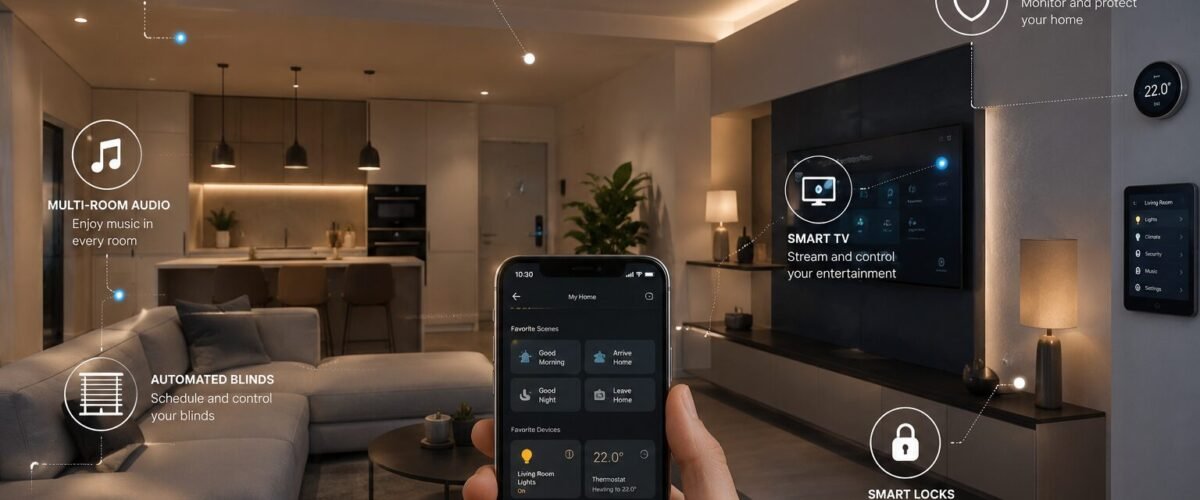
The smart home revolution has already reshaped how people manage lighting, security, and entertainment. Now, it’s moving into rooms that haven’t changed much in decades — the bathroom, the kitchen, and even the garage. Fixtures that were once purely mechanical are increasingly becoming connected devices, equipped with sensors, automation, and app-based controls that improve efficiency, hygiene, and convenience.
This shift didn’t happen overnight. It followed the same trajectory as most consumer IoT categories: falling sensor costs, cheaper wireless chipsets, and growing consumer comfort with app-controlled devices created the conditions for manufacturers to rethink products that had barely changed in decades. The result is a new generation of fixtures that behave less like static hardware and more like connected appliances.
The Rise of the Smart Toilet
Perhaps the clearest example of this shift is the smart toilet. What began as a niche luxury product in select markets has evolved into a genuine home technology category. Modern smart toilets integrate several distinct systems:
- Sensor-based automation, allowing lids to open and flush automatically using proximity or motion sensors, reducing physical contact with the fixture.
- Water-flow optimization, where internal sensors adjust flush volume based on use, cutting water consumption compared to standard fixtures.
- Self-cleaning mechanisms, using UV light or electrolyzed water sprays to reduce bacterial buildup without manual scrubbing.
- App connectivity, in higher-end models, letting users monitor water usage data or receive maintenance alerts before a mechanical issue becomes a bigger repair.
These aren’t gimmicks — they represent a genuine convergence of plumbing engineering and consumer IoT design, similar to how thermostats evolved from simple dials into learning systems over the past decade.
Connected Kitchens: Beyond the Smart Fridge
Smart refrigerators get most of the attention in kitchen technology conversations, but the fixtures around them are quietly getting smarter too. Touchless and app-controlled taps now use similar sensor technology to hands-free soap dispensers, reducing contact points in a room where hygiene is a constant concern. Some systems allow precise temperature and flow presets to be saved and triggered with a voice command or a single tap — useful for anything from filling a pot to a specific volume to dispensing exactly boiling water for tea.
Underlying all of this is a shift in how kitchen fixtures are engineered: instead of being purely mechanical components, they’re increasingly built with embedded microcontrollers, enabling data logging and remote diagnostics that weren’t possible with traditional fittings.
Garage Doors Join the IoT Ecosystem
Garage doors have followed a similar automation trajectory. Early automatic openers simply replaced manual lifting with a motor and a remote. Today’s systems go considerably further:
- Smartphone-based control, allowing users to open, close, or check the status of a garage door from anywhere with an internet connection.
- Real-time alerts, notifying homeowners if a door has been left open or opened at an unexpected time.
- Integration with broader smart home ecosystems, so a garage door can trigger other actions — turning on interior lights, disarming a security system, or logging entry for shared households.
- Battery backup and encrypted communication protocols, addressing the security concerns that come with connecting a physical access point to the internet.
This last point is worth dwelling on. As with any connected device, a smart garage door increases the attack surface of a home network. Reputable manufacturers now build these systems around encrypted, authenticated communication rather than the simple radio-frequency signals used by older openers — a necessary evolution as more physical infrastructure becomes networked.
Why This Matters for Renovators and Builders
For anyone planning a renovation or new build, this shift changes how fixture decisions should be approached. Rather than treating bathroom, kitchen, and garage components as purely mechanical purchases, it’s worth evaluating them the way one would evaluate any other connected device:
- Software support and update cycles — does the manufacturer provide firmware updates, and for how long?
- Interoperability — does the fixture integrate with existing smart home platforms, or does it require a separate, proprietary app?
- Data handling — what usage data is collected, and how is it stored or shared?
- Security posture — is communication encrypted, and does the device require authentication for remote access?
These are the same questions consumers have learned to ask about smart speakers and security cameras, and they’re becoming just as relevant for smart toilets, connected taps, and app-controlled garage doors.
The Data Layer Behind Smart Fixtures
Every connected fixture generates data, and it’s worth understanding what happens to it before that data leaves the home. A smart toilet tracking water usage, or a garage door logging entry times, is quietly building a small but continuous dataset about household habits. In most consumer IoT products, this data flows through three stages.
Collection
Sensors capture raw signals — a flush event, a door opening, a tap being used — and timestamp them locally on the device.
Transmission
That data is sent, usually over Wi-Fi or a home hub, to either a local app or a manufacturer’s cloud service. This is the stage where encryption matters most, since unsecured transmission is the most common weak point in consumer IoT security.
Storage and Analysis
Once in the cloud, usage data may be aggregated to generate maintenance alerts, usage reports, or — in some cases — anonymized analytics used to improve future product generations.
None of this is inherently problematic, but it does mean fixture purchases now come with a data-handling dimension that didn’t exist a decade ago. Consumers evaluating a smart toilet or a connected garage door opener are, in effect, also evaluating a small IoT vendor’s data practices — whether they publish a clear privacy policy, whether data is anonymized, and whether it’s sold to third parties.
Interoperability and the Standards Question
One of the more practical challenges in this space is fragmentation. Unlike smart bulbs or plugs, which have largely converged around shared standards, bathroom, kitchen, and garage fixtures still tend to ship with proprietary apps and closed ecosystems. A smart toilet from one manufacturer may have no way to communicate with a garage door system from another, even if both are technically “smart.”
The broader smart home industry has been working to solve this exact problem through unified connectivity standards designed to let devices from different manufacturers communicate through a common protocol rather than requiring a separate app for every device. As these standards mature and see wider adoption across categories, fixture manufacturers are likely to face growing pressure to support them rather than locking customers into single-brand ecosystems. For homeowners, this is worth watching closely: a fixture that only works within its own app today may become considerably more useful — or considerably more obsolete — depending on how well it adapts to shared standards over the next few years.
What Installers and Trade Professionals Need to Know
The rise of connected fixtures also changes the skill set required to install and maintain them. A traditional plumber or garage door technician now often needs at least a working understanding of home networking — configuring Wi-Fi credentials, pairing devices with a hub, and troubleshooting connectivity issues that have nothing to do with pipes or motors.
This has created a small but growing overlap between trades that were previously entirely separate: plumbing, electrical, and low-voltage networking work. Builders managing renovation projects increasingly need to coordinate fixture installation with network setup, ensuring Wi-Fi coverage extends reliably into bathrooms, kitchens, and garages — spaces that weren’t historically prioritized in home network design. It’s a reminder that as fixtures become smarter, the trades responsible for installing them need to become more technically fluent too.
The Broader Trend
What’s happening in bathrooms, kitchens, and garages mirrors a pattern seen across the smart home industry more broadly: mechanical systems are being reengineered around sensors, connectivity, and software, turning static fixtures into data-generating, remotely manageable devices. As component costs for sensors and connectivity chips continue to fall, this trend is likely to expand further — from smart shower systems that pre-heat water on a schedule, to fully automated kitchen fixtures that adjust based on usage patterns over time.
For homeowners, the practical upshot is a home that’s more responsive and efficient. For the fixtures industry, it signals a shift from purely mechanical manufacturing toward genuine IoT product design — a change that’s likely to accelerate as smart home adoption continues to grow across residential and commercial properties alike.
Final Thoughts
The line between “home fixture” and “connected device” is steadily disappearing. As sensor technology, automation, and app connectivity become standard rather than premium features, bathrooms, kitchens, and garages are becoming the newest frontier in the broader smart home ecosystem — one flush, tap, and door at a time.

Hi, I’m Harvey Specter, part of the Sales & Marketing team at Vogue Fixtures, an Adelaide-based supplier of premium bathroom and kitchen fixtures, designer fittings, and garage doors. I help homeowners, builders, and trade professionals find the right products for their projects, combining quality and design with a simple, tailored buying experience.