
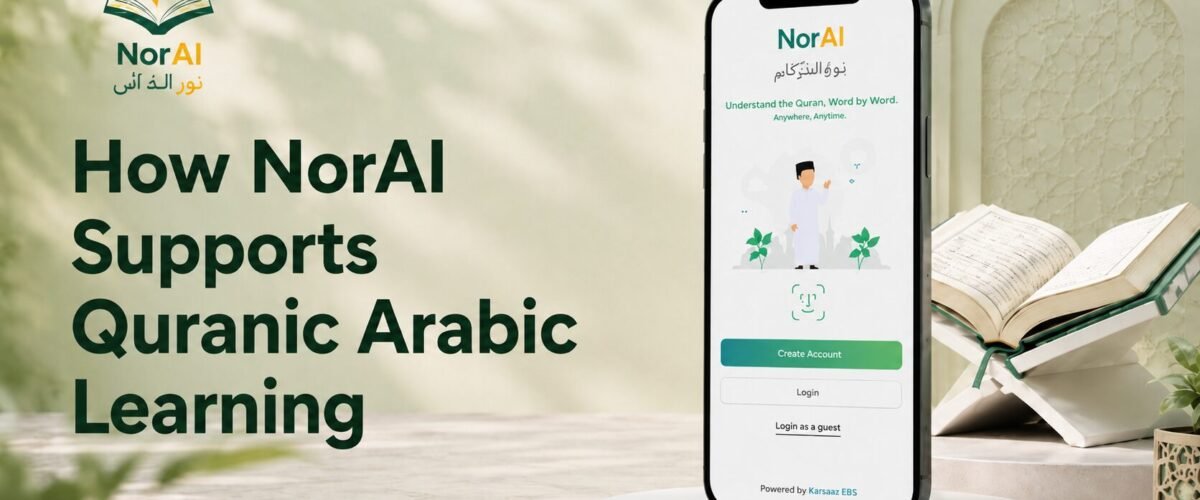
How NorAI Supports Quranic Arabic Learning
For many Muslims, reciting the Quran is already part of everyday life. Yet understanding the Arabic words being recited can be a separate challenge, especially for beginners, children, or adults who have never formally studied Arabic.
Learning Quranic Arabic does not have to begin with long grammar lessons or large lists of vocabulary. A learner can start with something much simpler: recognising one word, understanding its meaning, hearing how it sounds, and then meeting that same word again through practice.
This is the approach behind NorAI, a Quranic Arabic learning app designed to help learners build familiarity with Quranic vocabulary word by word.
Learning the Quran Through Its Words
The word Quran — الْقُرْآن (Al-Qur’an) is commonly understood as “the recitation” or “that which is recited.”
This connection with recitation is important because many learners already hear Quranic Arabic regularly. They may recognise the sound of a verse without necessarily knowing what individual words mean.
Word-by-word learning can begin to close that gap.
Instead of treating an entire verse as one unfamiliar block of Arabic, learners can gradually become familiar with individual words. When those words appear again during recitation, they may begin to feel more recognisable.
NorAI is built around this gradual learning process.
A Structured Path Instead of Random Vocabulary
One challenge with learning Quranic Arabic independently is knowing where to begin.
Studying random words may help build some vocabulary, but it does not always create a clear path from beginner-level reading to stronger recognition.
NorAI follows a structured curriculum organised into 20 levels. The journey begins with basic Arabic reading foundations before gradually moving towards Quranic nouns, pronouns, particles, verbs, short phrases, and controlled Quranic context.
Learners can explore more about this structured approach through the NorAI learning features.
This means learners are not expected to understand everything immediately. Each stage builds on what has already been introduced.
The aim is steady familiarity rather than rushing through large amounts of material.
Visual Learning Makes New Words Easier to Approach
Arabic vocabulary can feel abstract when a learner sees a word for the first time.
NorAI uses clear visuals alongside Quranic words to support understanding. A learner can see the Arabic word while also connecting it with a visual representation of its approved meaning.
This does not replace the Arabic itself. The visual simply gives the learner another way to form a connection with the word.
For children and visual learners in particular, this can make unfamiliar vocabulary feel easier to approach.
NorAI combines visual learning with audio, articulation guidance, and guided writing as part of its core learning system.
Hearing the Word as Well as Seeing It
Quranic Arabic is not only read. It is heard and recited.
That is why NorAI includes recitation audio alongside written vocabulary.
A learner can see a word, understand its meaning, and hear how it is pronounced. Repeated exposure helps connect the written form with the sound of the word.
Over time, this can also support recognition during Quran recitation. A word that once sounded unfamiliar may begin to stand out because the learner has already encountered it during practice.
Audio learning therefore works together with visual recognition rather than functioning as a separate activity.
Articulation Guidance for Arabic Sounds
Arabic includes sounds that may be unfamiliar to learners who did not grow up speaking the language.
NorAI includes articulation guidance to help learners understand how Arabic sounds are formed and practised.
This feature is designed as learning support rather than a replacement for formal Tajweed instruction. NorAI focuses on Quranic Arabic vocabulary and understanding, while Tajweed and detailed recitation correction are areas learners should continue studying with qualified teachers.
Keeping that distinction clear allows the app to stay focused on its main purpose: helping learners understand Quranic words.
Guided Writing Builds Familiarity
Learning can become stronger when a learner interacts with a word in more than one way.
NorAI includes guided Arabic writing activities that help learners become familiar with Arabic letter shapes and movements.
Writing a word creates a different kind of engagement from simply looking at it.
A learner may first see the word, hear it, connect it with its meaning, and then practise its written form. Each interaction reinforces familiarity from a different direction.
Scholar-Reviewed Meanings
When Quranic vocabulary is being taught, accuracy matters.
NorAI does not use AI to generate Quranic meanings, translations, or religious explanations. Its Quranic content goes through a structured scholarly review and approval process before publication.
You can learn more about the people and process behind this content on the NorAI Scholars page.
The platform also maintains clear boundaries around what it teaches.
NorAI focuses on Quranic Arabic vocabulary and approved word meanings. It does not provide tafseer, fatwa, religious rulings, or AI-generated Quranic interpretation.
That distinction helps keep lessons focused and avoids turning vocabulary practice into open-ended religious interpretation.
Practice Is About Retention, Not Just Completion
Completing a lesson does not always mean a word has been remembered.
A learner may answer correctly today and forget the same word a few days later.
NorAI addresses this by separating progress from mastery.
Progress shows that a learner has completed a lesson or moved forward. Mastery reflects whether a word continues to be recognised across different sessions over time.
Words can move through stages such as New, Learning, Review, and Mastered.
This creates a more useful picture of learning because it focuses not only on what the learner has completed, but also on what they are actually retaining.
Learning at a Comfortable Pace
Not every learner progresses at the same speed.
Some learners may recognise new words quickly, while others need to see the same vocabulary several times before it becomes familiar.
NorAI allows practice to adjust around this difference.
When more practice is needed, familiar words can return more often. When recognition becomes stronger, additional vocabulary can gradually be introduced.
There is no need for every learner to follow exactly the same pace.
This is particularly useful for families because children can learn without feeling that they are falling behind someone else.
Learning Can Continue Offline
Internet access should not decide whether a learner can continue studying.
NorAI is designed around an offline-first learning model. Downloaded learning content can remain available on the device, while learning progress can be stored locally and synchronised later when internet access returns.
This makes Quranic Arabic learning more practical during travel, in areas with unreliable internet, or simply when a family wants to reduce online distractions.
Core learning is designed to continue without depending on a live connection.
A Learning Environment for Families and Adults
NorAI is designed for different types of learners, including adults, children, and families.
For minor learners, the learning experience remains separate from billing and subscription controls. Children are not shown pricing, advertisements, payment prompts, or account-management features while learning.
Parents can also use family tools to follow learning progress where those features are available within their plan. More details are available on the NorAI for Families page.
This keeps the learner focused on the lesson while account and subscription decisions remain with the adult.
Understanding Quranic Arabic One Word at a Time
Learning Quranic Arabic is a long-term process.
No app can replace qualified teachers, scholars, or formal religious education. But a structured learning tool can make everyday vocabulary practice easier to maintain.
NorAI supports that process by combining scholar-reviewed meanings, visual learning, recitation audio, articulation guidance, guided writing, repeated practice, and structured progression.
Instead of asking learners to understand everything at once, the approach begins with one word.
See it. Hear it. Understand its approved meaning. Practise it. Recognise it again.
Over time, those individual words can become familiar parts of the Quran a learner already reads and hears.
Further Reading
If you are interested in how modern digital platforms are designed to remain reliable and well organised, you may also explore The Sports Angel’s guide to building audit trails and activity logs, which looks at how digital systems record important activity and maintain accountability.
You can also read the complete beginner’s guide to CRM system structure for a broader look at how structured digital platforms organise information, relationships, and workflows.

NorAI is a Quranic Arabic learning app designed to help children, adults, and families understand the Quran word by word. It combines structured lessons, visual learning, recitation audio, articulation guidance, guided writing, and regular review to build stronger recognition of Quranic vocabulary. NorAI follows a structured 20-level learning journey, supports offline learning, and uses scholar-reviewed content. The learner experience is ad-free, while family features allow parents to manage learner profiles and follow progress in a safe, focused environment.