
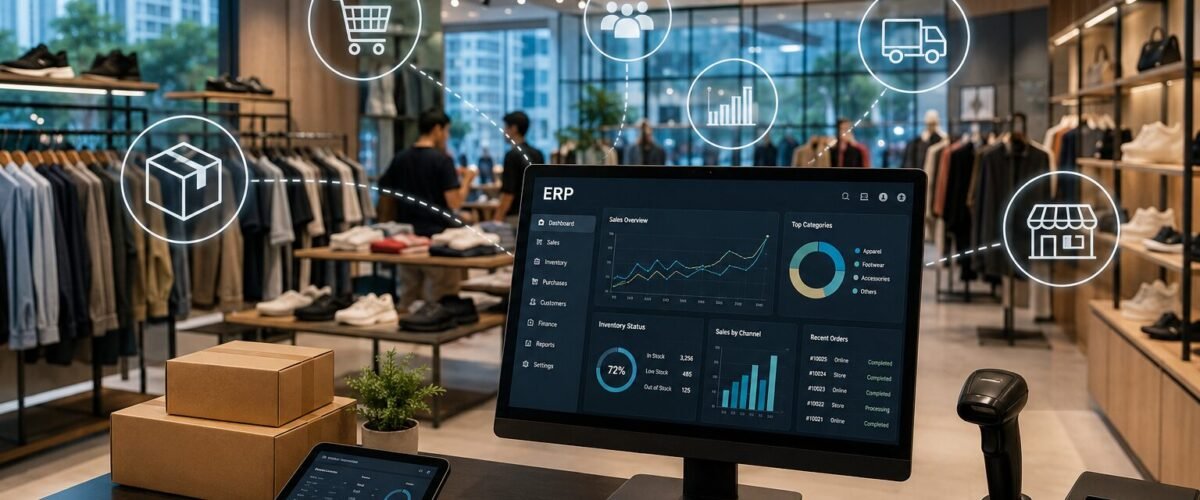
Singapore’s retail sector has always operated at a fast pace, but the last few years have accelerated it even further. Rising rental costs, tighter labour markets, and shoppers who move seamlessly between physical stores and online channels have forced retailers to rethink how they run their back-end operations. At the centre of that shift sits the ERP system, a piece of infrastructure that used to be associated mainly with manufacturing and large enterprises but is now becoming standard across retail businesses of every size.
Why Retail in Singapore Needed a Different Approach
Retail in Singapore isn’t a single, uniform market. A neighbourhood grocery chain in Tampines faces different pressures than a fashion brand in Orchard Road managing both a flagship store and an e-commerce storefront. What ties them together is the need to know, in real time, what’s happening across inventory, sales, and customer demand.
For years, many retailers relied on separate tools: one system for point-of-sale, another spreadsheet for inventory, a third platform for accounting, and increasingly, a separate dashboard for online orders. Each system worked fine on its own, but none of them talked to each other. Stock counts drifted out of sync, finance teams spent days reconciling numbers at month-end, and store managers often made decisions based on information that was already a day or two old.
An ERP system Singapore retailers can rely on solves this by pulling these functions into one connected environment. Instead of separate silos, sales, stock, procurement, and finance data all live in the same place and update as transactions happen.
What Actually Changes on the Ground
The practical impact of consolidating operations shows up in a few specific ways.
Inventory becomes visible across every location. A retailer with stores in Jurong, Bugis, and Ang Mo Kio, plus an online store, can see exact stock levels for every SKU in every location at the same time. If a product runs low at one outlet but sits in surplus at another, staff can transfer stock before a customer walks away empty-handed, rather than discovering the mismatch during a physical count weeks later.
Reordering stops being guesswork. With historical sales data connected directly to procurement, the system can flag when stock for a fast-moving item is likely to run out, factoring in lead times from suppliers. This matters particularly for retailers dealing with imported goods, where restocking isn’t instant and a missed reorder window can mean weeks of lost sales.
Finance teams spend less time reconciling and more time analysing. When sales, returns, and supplier payments feed into the same ledger automatically, the manual work of matching numbers across systems largely disappears. Reports that used to take days to prepare can be generated in minutes, giving finance leaders a clearer, more current view of margins and cash flow.
Compliance becomes less of a scramble. Singapore’s GST requirements and IRAS reporting standards mean retailers need accurate, well-organised records. An integrated system that captures transactions correctly from the point of sale reduces the last-minute cleanup that often happens before filing deadlines.
The Omnichannel Reality
Singaporean shoppers don’t think in terms of “online” versus “offline” anymore. Someone might browse a product on their phone during their commute, check availability at a nearby outlet, and then either walk in to buy it or have it delivered. Retailers who can’t connect these touchpoints end up with fragmented data and frustrated customers, whether that’s a website showing an item as available when it’s actually sold out in-store, or a loyalty programme that doesn’t recognise a customer who shops across both channels.
A connected system gives retailers a single, accurate source of truth for stock and customer activity, regardless of where a transaction happens. This isn’t a nice-to-have anymore; it’s closer to a baseline expectation from shoppers who are used to frictionless experiences from larger regional and global retailers.
Labour Constraints Are Part of the Equation Too
Singapore’s retail sector has long dealt with manpower limitations, and this shapes how retailers think about technology adoption. Automating routine tasks such as stock reconciliation, purchase order generation, and basic reporting frees up staff to focus on customer-facing work rather than administrative tasks. For smaller retail teams in particular, this isn’t just about efficiency; it’s often what allows a lean team to manage multiple outlets without being stretched thin.
Considerations Before Adopting a System
Bringing in an integrated platform isn’t something to approach lightly. A few points tend to matter most for retailers weighing this decision:
- Scalability: A system that fits a five-outlet operation today should be able to handle expansion into new outlets or new channels without requiring a complete overhaul.
- Integration with existing tools: Point-of-sale hardware, payment gateways, and e-commerce platforms already in use need to connect cleanly with the new system, rather than requiring a rip-and-replace approach.
- Staff readiness: Even the most capable system underperforms if staff aren’t properly trained to use it. Change management and onboarding time should be factored into any rollout plan.
- Local compliance support: Given Singapore’s specific tax and reporting requirements, the platform needs to handle local regulations correctly out of the box, or through proper configuration.
Looking Ahead
Retail in Singapore will keep evolving, shaped by shifting consumer habits, tighter margins, and growing competition from regional e-commerce players. Retailers that maintain clear, real-time visibility into their operations are better positioned to respond to these shifts quickly, whether that means adjusting stock levels, spotting a demand trend early, or making pricing decisions based on current data rather than outdated reports.
Integrated business systems aren’t a silver bullet, and adopting one doesn’t automatically solve operational problems. But for retailers dealing with the complexity of multiple locations, channels, and increasingly demanding customers, having accurate, connected data across the business has become less of a competitive advantage and more of an operational necessity.

Serpent Consulting Services is a global technology and ERP solutions company helping businesses streamline operations, improve productivity, and accelerate digital transformation. We specialize in Odoo ERP, ERP development, customization, implementation, integration, and business management solutions across industries. Our expertise also includes Python, DevOps, Magento, Android, and MS SQL technologies. With industry-focused solutions and a customer-centric approach, SerpentCS helps organizations build smarter, connected, and scalable business operations.