
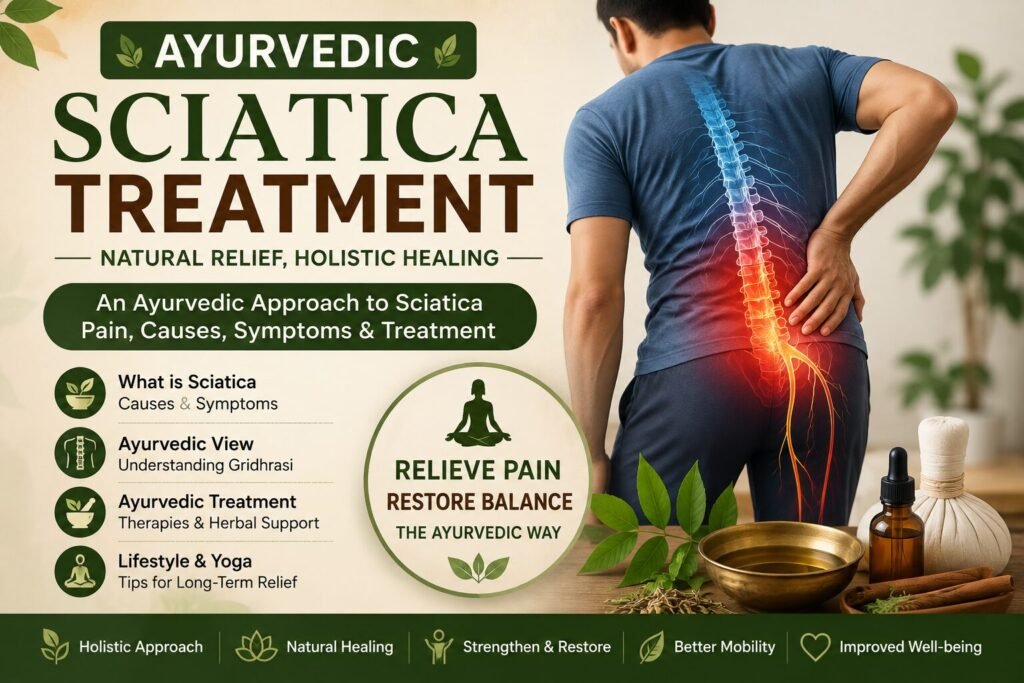
Ayurvedic Sciatica Treatment: Understanding Gridhrasi and the Ayurvedic Approach

Sciatica can cause pain that travels from the lower back or buttock down the back of the leg, sometimes accompanied by tingling, numbness, or weakness. It can develop when the sciatic nerve is irritated or compressed, with causes including a slipped disc, spinal narrowing, or certain back injuries.
People searching for Ayurvedic sciatica treatment often want to understand how Ayurveda approaches recurring back and leg discomfort. In classical Ayurveda, a pattern of pain resembling sciatica is commonly discussed under the term Gridhrasi. The traditional approach considers the person’s overall condition, daily routine, digestion, activity, sleep, and other individual factors before suggesting appropriate care.
What Is Sciatica?
Sciatica is not simply ordinary lower-back discomfort. Its characteristic feature is pain or other sensations that travel along the path of the sciatic nerve, commonly affecting the buttock and one leg. Some people may experience burning or sharp pain, tingling, numbness, or weakness.
The underlying cause matters. A slipped disc is one of the more common causes, but spinal narrowing, vertebral displacement, and back injuries can also contribute.
Because several conditions can produce similar symptoms, persistent or significant symptoms should be properly assessed rather than automatically attributed to sciatica.
How Ayurveda Describes Sciatica
Ayurvedic texts describe Gridhrasi as a condition characterized by pain that follows a pathway resembling the distribution of the sciatic region. The traditional Ayurvedic understanding focuses on disturbances involving Vata, with the exact interpretation depending on the individual’s presentation.
Rather than viewing discomfort in isolation, Ayurveda traditionally considers factors such as:
- Daily activity and movement
- Sitting and working habits
- Sleep and rest
- Food and digestion
- Physical exertion
- Seasonal changes
- Individual constitution and lifestyle
This whole-person perspective is one reason people explore Ayurveda as part of their approach to back and leg wellness.
What Is the Ayurvedic Approach to Sciatica?
An Ayurvedic consultation generally begins with understanding the individual’s symptoms, routine, lifestyle, and overall health patterns. Based on this assessment, an Ayurvedic practitioner may consider traditional therapies and lifestyle guidance appropriate to the person’s needs.
Ayurvedic approaches may include traditional oil applications, gentle body therapies, massage-based practices, heat-based therapies, yoga or movement guidance, and other classical procedures where appropriate.
One commonly discussed Ayurvedic therapy is Kati Basti, in which warm herbal oil is traditionally retained over the lower-back region within a specially prepared boundary. Other therapies may be considered depending on the individual’s presentation.
The important point is that Ayurvedic care should not be treated as a standardized package. The suitability of a particular therapy depends on the person and should be determined after an appropriate consultation.
Can Ayurveda Cure Sciatica?
It is important to distinguish between traditional Ayurvedic support and a guaranteed cure.
Ayurveda may provide a holistic approach to managing comfort, movement, lifestyle, and overall wellbeing, but there is not sufficient high-quality evidence to claim that Ayurvedic treatment can reliably remove a structural cause such as a herniated disc or spinal narrowing.
Modern evidence also shows that the effectiveness of nonsurgical interventions for sciatica varies, and recent systematic reviews have generally rated the certainty of evidence for many interventions as low or very low.
Therefore, individuals with persistent or significant symptoms should seek appropriate professional evaluation while considering any complementary approach.
Ayurvedic Lifestyle Guidance for Back and Leg Wellness
Daily habits can be an important part of maintaining physical wellbeing.
Avoiding prolonged periods of sitting, maintaining appropriate movement, and gradually returning to normal activities can be helpful for many people with sciatica. The NHS advises staying as active as possible and avoiding prolonged sitting or lying down.
From an Ayurvedic perspective, a balanced routine may include:
Maintain Regular Movement
Long periods of inactivity can make everyday movement more difficult. Gentle activity appropriate to your condition may help maintain mobility.
Pay Attention to Sitting Habits
People who spend several hours working at a desk should pay attention to posture, workstation setup, and regular movement breaks.
Follow a Consistent Daily Routine
Ayurveda traditionally places importance on regularity in sleeping, eating, working, and resting.
Avoid Sudden Physical Strain
Heavy lifting or sudden movements can aggravate back discomfort in some individuals. Safe movement and appropriate technique are important.
Support Healthy Sleep
Adequate and comfortable sleep is an important part of general wellbeing and recovery.
When Should You See a Doctor?
Not every case of leg or back pain should be managed at home or through complementary care.
You should seek professional evaluation if symptoms are getting worse, interfering with normal activities, or not improving after a period of appropriate self-care.
Urgent medical assessment is particularly important if you develop severe or worsening weakness or numbness in both legs, numbness around the genitals or anus, difficulty starting urination, loss of bladder control, or loss of bowel control. These can indicate a serious spinal problem requiring urgent attention.
Ayurveda and Sciatica: A Balanced Approach
Ayurvedic sciatica treatment is best understood as a traditional, individualized approach to supporting overall musculoskeletal wellness. Ayurveda may focus on lifestyle, routine, traditional therapies, movement, and the person’s broader health patterns rather than treating discomfort in isolation.
For individuals interested in Ayurvedic treatment for sciatica, a responsible approach begins with understanding the likely cause of the symptoms. Where necessary, appropriate diagnostic evaluation should come first. Ayurvedic care can then be discussed as a complementary or individualized wellness approach.
At Ayusanjivani Ayurveda Clinic & Panchakarma Centre Wagholi, consultations can focus on understanding individual lifestyle patterns and explaining relevant Ayurvedic principles in a practical manner. The emphasis should always remain on informed decisions, realistic expectations, and care appropriate to the individual’s needs.
Frequently Asked Questions
What is sciatica called in Ayurveda?
A condition with symptoms resembling sciatica is traditionally discussed under the Ayurvedic term Gridhrasi.
Can Ayurveda help with sciatica?
Ayurveda offers traditional approaches involving lifestyle guidance and selected therapies. However, it should not be presented as a guaranteed cure for nerve compression or structural spinal problems.
Is Kati Basti used for back discomfort?
Kati Basti is a traditional Ayurvedic therapy involving the application and retention of warm oil over the lower-back region. Its suitability should be determined by an appropriately qualified practitioner.
Should I get my symptoms evaluated before Ayurvedic treatment?
Yes, particularly when symptoms are persistent, severe, worsening, or accompanied by numbness or weakness. Identifying the underlying cause helps determine the appropriate course of care.
Can I stay active with sciatica?
Many people are encouraged to maintain gentle activity rather than prolonged bed rest, but the appropriate level of movement depends on the individual’s condition. Professional guidance is advisable when symptoms are significant.
visit us today for appointment.

Free contributor opportunity
List your business, then unlock your own Guest Post.
Self-register for free and connect your expertise to a public business profile.