
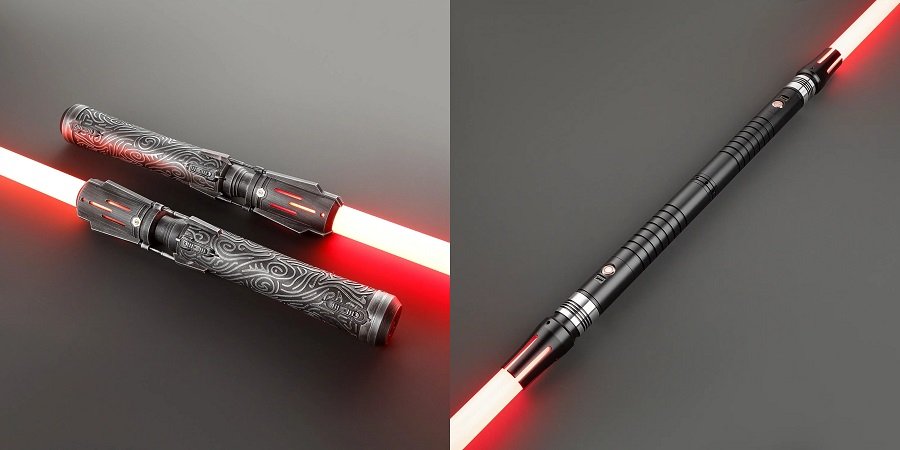
Double Sided Lightsabers — Why the Saberstaff Design Remains One of the Most Visually Striking Builds in the Hobby

Single-blade lightsabers dominate the market for good reason — they’re the most common design across the franchise, they suit the widest range of use cases, and the collection of available hilt designs is enormous. However, in the serious collectors’ or serious martial practitioners’ world, the double sided lightsaber does have a certain position to which single blade simply cannot come. There is a physical presence and handling requirement, and the combat technique is inherently unique, and has come about from a dual configuration, rather than a standard one.
Understanding what that difference actually involves helps buyers approach the category with realistic expectations rather than assumptions carried over from single blade experience.
What a Double Edge Lightsaber Actually Is
The double-edge lightsaber — often called a saberstaff or double-bladed lightsaber — features a blade extending from both ends of a central hilt. The design appeared memorably in the film saga and has appeared across animated series, games, and expanded universe material in configurations that vary from the original screen reference.
The hilt itself is longer than a standard single-blade design by necessity — it needs to provide grip space between the two blade emitters while keeping the overall weight distribution balanced enough for practical handling. The central grip section is where the design lives or dies. Too short and the wielder’s hands don’t have adequate separation. Too long and the balance shifts awkwardly. The proportion decisions in a double edge lightsaber hilt matter more than in a single-blade design because the physics of handling a two-blade configuration amplify any imbalance.
Handling a Double Sided Lightsaber — What Changes From Single Blade
Anyone approaching a double-sided lightsaber for the first time with choreography or active use in mind needs to recalibrate expectations built from single-blade experience. The weight distribution is fundamentally different — a single-blade build has most of its mass in the hilt and chassis, with the blade extending in one direction. A dual-blade configuration distributes mass across a longer total length with blades extending in both directions from a central point.
Spinning and rotational techniques that are relatively simple with a single blade become more complex with a dual blade because the second blade introduces a counterweight effect that changes how rotational momentum builds and dissipates. The fighting styles developed around this weapon type in the franchise reflect this — the choreography leans into sweeping rotational movement that uses the second blade’s momentum rather than working against it.
For display and cosplay applications, the handling difference is less critical than the visual presence. A double-sided lightsaber with both blades ignited produces a visual footprint that commands attention in a way that no single-blade build matches.
Sound and Electronics for a Dual Blade Configuration
The electronics in a dual-blade lightsaber need to power two blades simultaneously from a chassis mounted in the central hilt section. This creates design constraints that single-blade builds don’t face — battery capacity needs to be sufficient for two blades rather than one, and the sound board needs to handle the activation sequence for both simultaneously or in the sequential ignition pattern that some designs use.
Neopixel dual-blade builds add another layer of complexity — two individually addressable blade strings running from a central chassis require more careful management than a single string. When this is executed properly, the result is a dual-blade Neopixel build where both blades display smooth ignition animations, tip effects, and clash response. The visual impact is significant.
Sound fonts for a double-sided lightsaber build ideally reflect the combat style associated with the design — the sound profile should suit the rotational, sweeping movements the weapon type produces rather than defaulting to sound fonts designed around single-blade combat patterns.
Blade Length Decisions for Double Blade Builds
Standard blade length for single-blade lightsabers sits around 82 to 92 centimetres depending on the build and preference. Dual-blade configurations require a decision about whether both blades run the same length or whether an asymmetric configuration is preferred.
Symmetric configurations — equal-length blades on both ends — produce a balanced visual presentation and suit display use. They also provide even balance for spinning techniques. Asymmetric configurations — one blade longer than the other — reflect certain character references and can suit combat styles where one end is used primarily as the striking blade.
Blade material remains the same as single-blade builds — polycarbonate in combat-grade wall thickness for active use, thinner options for display where weight reduction matters more than impact resistance.
BM Lightsabers carries dual-blade lightsaber builds alongside single-blade configurations — Neopixel and standard blade options, aluminium hilt construction, and worldwide shipping. Full range at BM Lightsabers.
A dual-blade build done properly is a genuinely different experience from anything a single-blade produces. The visual presence, the handling demands, and the combat style enable it to occupy territory that the rest of the collection doesn’t cover.

Discover BM Lightsabers’ galaxy of the most lifelike lightsabers available for purchase. Purchase stylish and high-quality lightsabers online for collectors, cosplayers, and fans to have the best possible experience. Order your amazing lightsabers right now!